The Tom Thumb Replica Returns to Ellicott City After 23 Years in Storage

Two journeys. Nearly two centuries apart.
The first began at Mount Clare on August 28, 1830. Peter Cooper’s experimental locomotive carried B&O Railroad leaders west from Baltimore to Ellicott’s Mills. It was a public test of a new and uncertain form of power.
The second journey has just been completed. It carried no passengers and proved no engineering theory. Instead, it brought an important piece of railroad history out of storage and back into public view.
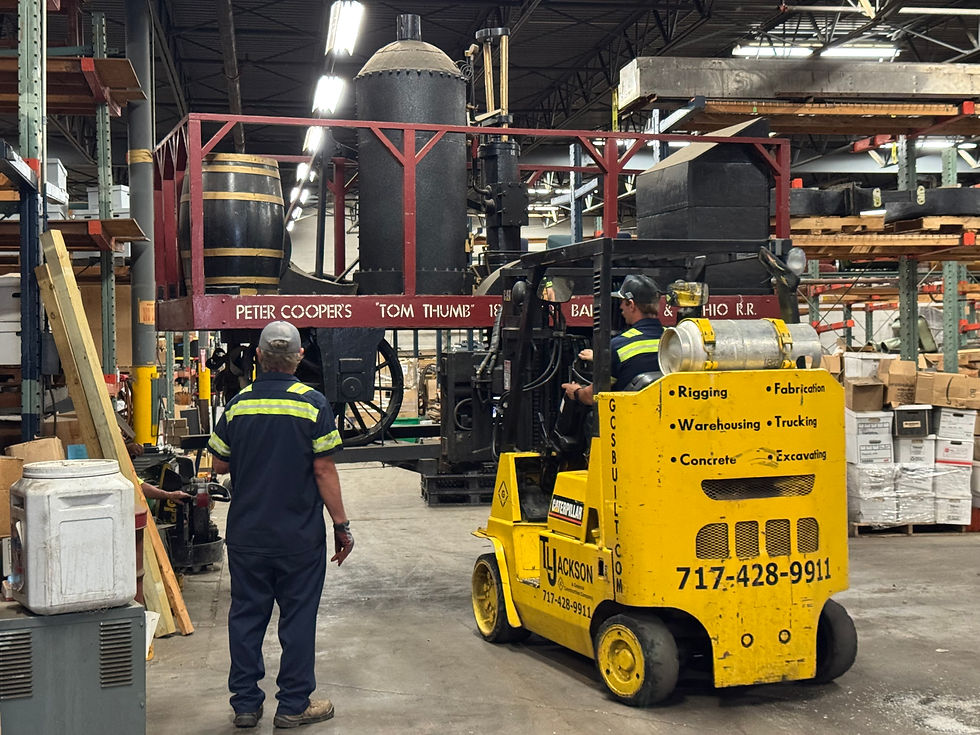
This time, the traveler was not Cooper’s original locomotive. It was the oldest surviving full-size representation of it. The rarely seen Tom Thumb model created under the direction of Joseph G. Pangborn for the 1893 World’s Columbian Exposition in Chicago.
After more than two decades in storage, the Pangborn Tom Thumb has arrived at the B&O Ellicott City Station Museum.
I had the rare privilege of helping with the move.
A journey west, then and now
On August 28, 1830, the original Tom Thumb left Baltimore under its own power.
It was small, improvised, and experimental. Its upright boiler, single cylinder, geared drive, and forced-draft blower had been assembled to answer a practical question: could a locomotive operate over the Baltimore & Ohio Railroad’s curves and grades?
The B&O was already carrying passengers to Ellicott’s Mills behind horses. That service had proved popular. But the railroad was meant to reach far beyond thirteen miles. Its leaders needed a form of power capable of carrying heavier loads over greater distances.
Cooper believed steam could do it.
His locomotive carried a substantial party over the railroad to Ellicott’s Mills. The surviving accounts disagree about the exact number of passengers, but the purpose of the journey is clear. Cooper was demonstrating that an American-built steam locomotive could operate over the B&O’s actual railroad.
The engine completed the journey. It negotiated the curves, climbed the grades, and returned to Baltimore. It was too small and too lightly constructed for regular service, but that was not the point.
The experiment worked.
The journey just completed by the Pangborn model carried a different meaning. It traveled from a Baltimore storage facility to Ellicott City with the help of museum professionals, volunteers, transportation equipment, and careful planning.
The original journey helped open the future.
The new journey helps preserve its memory.




The original steam locomotive, and the replicas
There is no surviving original Tom Thumb.
Cooper’s experimental locomotive was never intended to become a permanent museum object. It was a temporary machine assembled from available parts for a specific demonstration. The B&O Railroad Museum reports that it was eventually salvaged for parts.
What survives today are later attempts to show people what the locomotive may have looked like.
Two of those representations are especially important. They are often confused, but they are not the same.
The Tom Thumb now at the B&O Ellicott City Station Museum is the Pangborn version. It was created for the 1893 World’s Columbian Exposition.
The better-known operating replica was built by the B&O for the 1927 Fair of the Iron Horse. It remains at the National Museum of Railroad History & Innovation in Baltimore.
One was made to be seen.
The other was made to move.
Pangborn’s vision of the Tom Thumb
By 1893, the railroad had transformed the United States.
Tracks crossed the continent. Locomotives hauled enormous quantities of freight. Passenger trains connected cities and towns at speeds that would have seemed astonishing in 1830. Railroads had become powerful corporations and symbols of national expansion.
The 1893 World's Fair, officially known as the World's Columbian Exposition, gave the railroad industry an opportunity to display that achievement.
Joseph G. Pangborn, a special representative of the B&O, organized an ambitious historical railroad exhibit for the fair. Its title matched the scale of the undertaking, “The World’s Railway: Its Conception, Inception and Perfection"
Pangborn’s exhibit included full-size wooden models representing important steps in locomotive development. Among them were versions of Stephenson’s Rocket and several early American locomotives.
The Tom Thumb was part of that procession.
Pangborn’s model was not built from Cooper’s original drawings. No complete set of those drawings is known to survive. Instead, the model represented a late nineteenth-century attempt to reconstruct the machine from published descriptions, sketches, correspondence, and historical research.
That makes the Pangborn Tom Thumb two things at once.
It is a representation of an 1830 locomotive. It is also an artifact of 1893, a physical record of how Americans at the height of the railroad age understood and presented the origins of their technology.
The operating replica of 1927
Thirty-four years after the Chicago exposition, the B&O prepared to celebrate its centennial.
The 1927 Fair of the Iron Horse was part history, part pageant, and part declaration of institutional pride. Historic equipment and reconstructed locomotives appeared before large crowds to tell the story of a century of American railroading.
For that event, the B&O needed a Tom Thumb that could operate.
The result was the replica now displayed in Baltimore.
It followed the general appearance established through the surviving descriptions and the earlier model tradition, but it was not an exact mechanical copy of Cooper’s locomotive. It could not be.
What neither replica can tell us
Both Tom Thumb replicas are valuable. Neither should be treated as a complete mechanical record of the original.
No surviving construction drawing provides every measurement and detail. Eyewitnesses wrote years after the event. Their descriptions sometimes differ. Later historians filled gaps by comparing sketches, recollections, photographs, and known mechanical practices.
Some features are supported more strongly than others.
The original had an upright tubular boiler. It used a single vertical cylinder. Gearing increased the speed delivered to the wheels. A belt connected a road-wheel-driven drum to a blower that forced air through the fire and helped the small boiler produce enough steam.
Other details remain less certain. The number and exact size of the boiler tubes are unknown. The valve arrangement has not been firmly established. Even the familiar story that Cooper used musket barrels as boiler tubes comes from his much later recollection rather than a surviving construction record.
The replicas make the machine visible.
They do not eliminate the gaps in the evidence.
Why Ellicott City matters
The Pangborn model could have returned to public display in many places. Ellicott City gives it unusual meaning.
This was the destination that mattered in 1830, when the original Tom Thumb visited here several times.
The first thirteen miles between Baltimore and Ellicott’s Mills gave the B&O a working railroad on which to test its ideas. Horse-powered passenger service had begun in May. A few months later, Cooper’s locomotive traveled over the same route and demonstrated that steam could handle the railroad’s curves and grades.
Ellicott’s Mills was not merely the end of the line.
It was the place where the B&O’s technological future was tested, and it passed.
Now, inside the surviving railroad station and museum complex, visitors can encounter the Pangborn model at same destination connected with the original locomotive’s most important journey.
The model has not returned to the exact world of 1830. That world is gone. But it has arrived in a place where the story can be understood with unusual clarity.
Here, the name Ellicott’s Mills is not an abstraction on an old timetable. The route has a destination. The experiment has a setting. The locomotive’s purpose becomes easier to see.
The B&O Ellicott City Station Museum is the oldest railroad station in the United States. Built in 1831, it was the terminus of the first thirteen miles of Baltimore and Ohio Railroad.
Helping history move
Moving a historic object is rarely dramatic in the way history books describe dramatic events.
There are no cheering crowds. No bands. No directors leaning forward as a strange little locomotive gathers speed.
There is planning.
Measurements must be checked. Doorways and floor surfaces must be considered. The model’s weight, age, balance, and vulnerable parts must be understood. Equipment must be positioned carefully. Each movement must be deliberate.
All forms of transportation are needed including roadways, forklifts, rail carts, heavy duty trucks, and trailers.
A historic object may remain still for decades. Moving it safely can require patience measured in inches.
That is why helping with this move was such a privilege.
I volunteer at the B&O Ellicott City Station Museum. Most museum work happens quietly. Volunteer docents guide visitors, answer questions, assist with programs, watch over displays, keep the model trains running, and perform the many ordinary tasks that keep a historic site open.
Then a day comes when the connection to history feels especially direct.
An object that has spent more than two decades in storage begins to move. A careful team guides it through each stage of the journey. The doors of another historic space open.
And the Pangborn Tom Thumb enters Ellicott City.
An artifact with more than one history
The model now has several dates attached to it.
The first is 1830, the year of the locomotive it represents.
The second is 1893, the year Pangborn’s model appeared at the Chicago World’s Fair.
The third is the present, when the model returned to public view at the B&O Ellicott City Station Museum.
Each date adds another layer.
The original Tom Thumb represents experimentation. It recalls a moment when the future of railroad power remained uncertain and a tiny locomotive had to prove that steam could work on the B&O.
The Pangborn model represents remembrance. It shows how Americans in 1893 looked back from the height of the railroad age and tried to reconstruct its beginnings.
The model’s new display represents preservation and renewed access.
This is not one object pretending to be another.
Open to the Public
For more than two decades, the Pangborn model was protected but largely unseen.
Now visitors can study its proportions. They can compare it with photographs of the operating replica in Baltimore. They can ask why the two look different. They can learn why neither is identical to Cooper’s machine or the many drawings on the Internet.
Most important, they can place the Tom Thumb where it belongs, not at the end of a story about a race with a horse, but near the beginning of a much larger transformation.
The original locomotive traveled to Ellicott’s Mills to prove that steam could move the railroad forward.
The Pangborn model has now made its own journey to Ellicott City so that the public can look backward, and understand what that achievement meant.

Entry to the B&O Ellicott City Station Museum is free. It is open to visitors, and donations are appreciated. Please visit the website for information on operating days and hours. The museum spans two levels, accessible by stairs to the second floor. While there is no elevator, an accessible ramp is available outside the building in the Turntable Pit.
The first floor features a gift shop, restrooms, and the Freight Agent's Office. On the second floor, you'll find the Superintendent's Office / Women’s Waiting Room, the Telegraph and Ticket Office, the Men’s Waiting Room, and the Car House, which now contains the Tom Thumb Pangborn replica.
Beyond the platform doors lies an operational railway, originally part of the B&O Old Main Line and now part into CSX. At the distant end, you can explore the newly restored red caboose C2149, constructed in 1927, the locomotive turntable pit, a replica of the Pioneer car (B&O's initial horse-drawn passenger car), and the Freight House.
The Freight House contains a 40-foot-long HO-scale model that depicts the initial thirteen miles of the B&O Railroad, stretching from Baltimore to Ellicott City.
The Tom Thumb and the Road to Ellicott’s Mills SeriesPART 1 OF 4 · HISTORY AT ELLICOTT CITY STATION Why Peter Cooper Built the Tom Thumb LocomotivePART 2 OF 4 · HISTORY AT ELLICOTT CITY STATION Building and Testing an Experimental LocomotivePART 3 OF 4 · HISTORY AT ELLICOTT CITY STATION The Journey to Ellicott’s Mills That Proved Steam Could WorkPART 4 OF 4 · HISTORY AT ELLICOTT CITY STATION Part 4: The Horse Race and Making the Tom Thumb Legendary (soon) |
Research notes
This article distinguishes Peter Cooper’s original 1830 experimental locomotive from Joseph G. Pangborn’s full-size wooden model created for the 1893 World’s Columbian Exposition and the operating replica constructed for the B&O’s 1927 Fair of the Iron Horse.
The original locomotive no longer survives. Neither replica should be treated as a precise mechanical copy. Dimensions and construction details must be attributed carefully because the evidence includes later recollections, reconstructed drawings, and measurements estimated from photographs.
Principal sources include Lawrence W. Sagle’s “The Tom Thumb: Little Known Facts About First Locomotive Built in America Slowly Come to Light,” published in the May 1948 Railway and Locomotive Historical Society Bulletin; J. Snowden Bell’s Early Motive Power of the Baltimore & Ohio Railroad; John H. B. Latrobe’s 1868 recollections; Peter Cooper’s later statements; Edward C. Mack’s Peter Cooper: Citizen of New York; and surviving B&O company reporting.


